
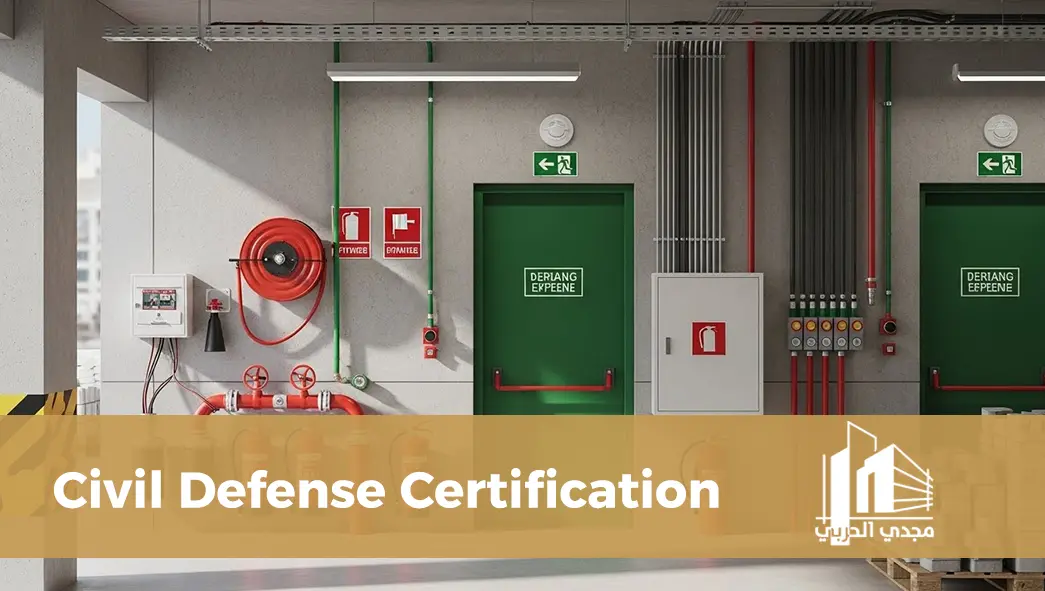
Civil Defense approval is considered the cornerstone of ensuring facility safety and protecting lives and property within the Kingdom of Saudi Arabia. It is a mandatory requirement for issuing or renewing commercial and industrial licenses. To obtain approval, the facility owner must comply with Civil Defense requirements that ensure the efficiency of firefighting and alarm systems and their conformity with international technical standards. Obtaining Civil Defense approval is not merely a legal procedure to avoid penalties; it is a preventive investment that reduces the likelihood of major incidents and ensures business continuity in accordance with the highest occupational safety standards.
What Are the Licensing Requirements?
To obtain Civil Defense licenses, the General Directorate of Civil Defense sets a range of requirements that vary depending on the type of activity and building area. The most important include:
Provision of firefighting systems:
Installing portable fire extinguishers, fire hose cabinets, and automatic sprinkler systems in large facilities.
Early warning alarm systems:
The necessity of installing smoke and heat detectors connected to a central control panel that activates during emergencies.
Approved safety plans:
Submitting engineering drawings that illustrate escape routes and fire equipment locations, duly signed by an accredited engineering office.
Compliance with technical regulations:
Ensuring that all electrical and mechanical installations comply with Civil Defense requirements to prevent electrical short circuits or gas leaks.
Safety signage:
Installing illuminated emergency exit signs and providing a clear, announced evacuation plan for employees and visitors.
What Are the Requirements for Using the Etimad Platform?
Many business owners inquire about the relationship between Civil Defense and digital platforms, especially when dealing with government projects:
Official registration:
The facility must be registered on the “Salama” platform affiliated with Civil Defense and linked to a valid commercial registration.
Electronic integration:
The Etimad platform allows contractors and engineering offices to upload certificates confirming the completion of preventive installations, ensuring compliance with government contract requirements.
Engineering authorization:
An accredited consultancy office must be authorized to conduct risk assessments and submit the required technical reports for final approval issuance.
How Much Does a Civil Defense License Cost?
The total cost of obtaining Civil Defense approval depends on several technical factors, including:
Government issuance fees:
Fixed fees based on the type of activity and site area, paid electronically.
Cost of safety equipment:
Including the purchase, installation, and maintenance of fire extinguishers, sprinklers, and fire hoses, which vary according to the quality of the brands used.
Annual maintenance contracts:
Civil Defense requires a valid maintenance contract with a specialized company to ensure system readiness at all times.
Engineering office fees:
Covering technical studies, risk assessment, and follow-up on license issuance through digital platforms.
What Is the Penalty for Not Having a Civil Defense License?
Failure to issue or renew Civil Defense licenses results in serious legal and financial consequences, including:
Substantial financial fines:
Fines start from minor amounts and escalate to thousands of Saudi riyals depending on facility size and violation severity.
Administrative closure:
Inspection teams have the authority to immediately close the facility if minimum fire protection measures are not met.
Loss of insurance coverage:
Insurance companies refuse to pay compensation in the event of a fire in a facility lacking Civil Defense approval.
Criminal liability:
In the event of injuries or fatalities—God forbid—the facility owner bears full criminal responsibility due to non-compliance with safety regulations.
The Importance of Risk Assessment in Obtaining Civil Defense Approval
Risk assessment is one of the most critical proactive steps carried out by specialized engineers. This study aims to identify building vulnerabilities, anticipate potential fire scenarios, and determine appropriate containment measures. Based on this assessment, suitable protection systems and procedures are designed to prevent fire spread and facilitate safe evacuation—an essential requirement for Civil Defense approval by technical committees.
The Role of Engineer Majdi Al-Harbi’s Office in Facilitating Civil Defense Licensing
Due to the complexity of technical standards, Engineer Majdi Al-Harbi’s Office provides integrated solutions to simplify obtaining Civil Defense approval. The office’s services include:
Safety system design:
Preparing firefighting and alarm system plans in accordance with the latest local and international codes.
Technical supervision:
Ensuring contractors properly install safety equipment in compliance with specifications.
Issuance of compliance certificates:
Conducting site visits to test systems and verify their effectiveness before submitting applications to Civil Defense.
Digital platform follow-up:
Managing facility accounts on the “Salama” and “Balady” platforms to ensure rapid issuance of Civil Defense licenses.
What Are the Essential Safety Tools Required for Every Facility?
No facility approved by Civil Defense is without essential safety equipment, including:
Fire extinguishers:
(Dry powder, carbon dioxide, foam) depending on the type of activity.
Fire hoses:
Supplied from dedicated emergency water tanks.
Automatic sprinkler systems:
Activated by heat detection to suppress fires at early stages.
Fire-rated doors:
Manufactured from fire-resistant materials designed to withstand flames for a specific duration (one or two hours) to prevent fire spread between building sections.
Procedures Followed During On-Site Civil Defense Inspections
When inspectors visit the site to grant Civil Defense approval, they focus on practical safety measures, including:
Testing the alarm control panel to ensure coverage of all facility areas.
Ensuring escape routes and emergency exits are free of obstructions.
Checking water pressure in firefighting networks and verifying pump operation (jockey and diesel pumps).
Reviewing periodic maintenance records of safety equipment issued by licensed companies.
How to Maintain the Validity of Civil Defense Licenses
Obtaining Civil Defense approval for the first time does not end the process; license validity must be maintained through:
Annual renewal at least one month before expiration.
Conducting regular evacuation drills for employees.
Updating risk assessment studies when structural modifications or activity changes occur.
Continuous coordination with a consultancy office such as Engineer Majdi Al-Harbi’s Office to stay aligned with ongoing updates to Civil Defense requirements.
Civil Defense approval remains the true safety valve for any economic activity in the Kingdom. Compliance with Civil Defense requirements is not merely regulatory adherence but a reflection of responsibility toward society and the built environment. By providing the best safety equipment and collaborating with safety experts, you can secure your facility and ensure uninterrupted business growth without legal obstacles.
To obtain Civil Defense approval for your facility with the highest quality standards, contact Engineer Majdi Al-Harbi’s Office today.