
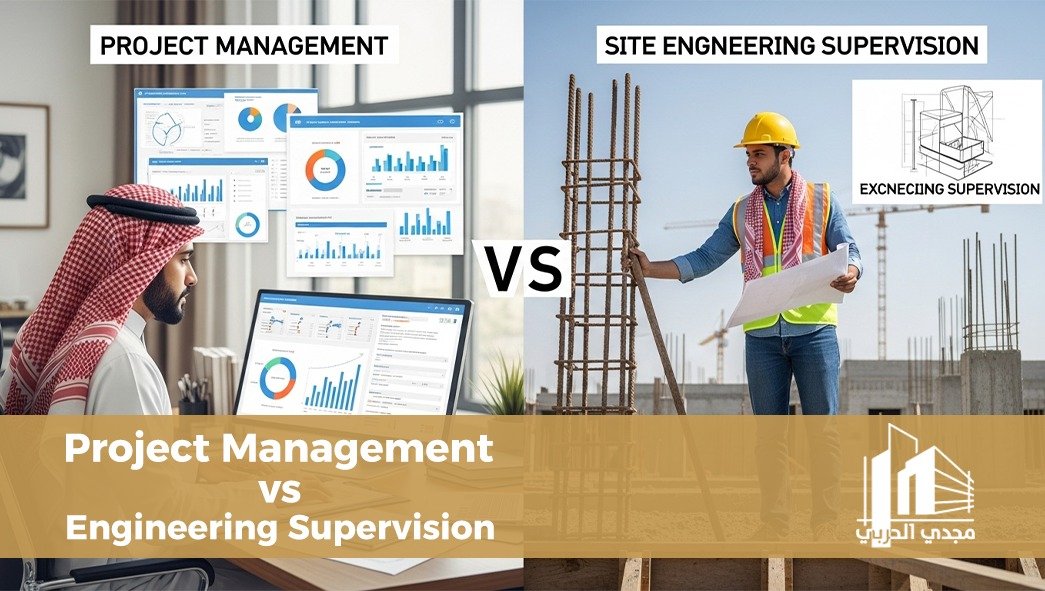
Many property owners and investors feel confused when starting their construction projects: does the project require a project manager, or is hiring a supervision office sufficient? And who is responsible for the quality of concrete pouring or delays in material deliveries?
The reality is that construction is a complex process similar to a musical orchestra: the contractor is the performer, the consultant monitors quality, and the project manager is the conductor who ensures that everyone works in harmony.
Understanding the difference between project management and engineering supervision is the first step toward protecting your budget and ensuring your home or facility is built according to the highest standards.
In this article, we will clarify the overlapping roles, explain the responsibilities of the contractor and consultant, and show how they complement each other under professional project management.
What Is Project Management in Engineering Projects?
Project management in the engineering sector is defined as the science and art of planning, organizing, and directing available resources to achieve specific objectives within three strict constraints: time, cost, and quality.
In engineering projects, management is not limited to organizing paperwork or meetings. It is a complex technical process that ensures the transformation of silent engineering drawings into functional and sustainable structures.
Project management acts as the engine that coordinates interactions between different disciplines—civil, architectural, mechanical, and electrical—while ensuring compliance with the Saudi Building Code and safety regulations.
In simple terms, project management ensures that the project is completed as planned without financial waste or technical deviations.
Who Is the Engineering Project Manager?
The engineering project manager is the professional engineer responsible for leading the project from concept to final delivery.
This role requires a unique combination of leadership skills, administrative capability, and deep technical expertise. The project manager does not simply sit behind a desk; they act as the owner’s primary advocate, the financial controller protecting the budget, and the field leader resolving conflicts between contractors and consultants.
In the project’s organizational hierarchy, the project manager sits at the top level, responsible for making strategic decisions that balance execution speed with output quality while ensuring full compliance with local regulations.
What Is Engineering Supervision in Construction Projects?
Engineering supervision refers to on-site technical oversight aimed at ensuring that construction activities are carried out precisely according to approved drawings, technical specifications, and professional standards.
The supervising engineer—or consultant—acts as the technical representative of the owner at the construction site. Their main responsibility is to ensure quality and prevent architectural or structural errors before they occur.
The consultant’s role focuses on ensuring that all work performed on-site exactly matches the approved drawings and the Saudi Building Code.
Key Responsibilities of the Supervising Consultant
Drawing compliance: ensuring the contractor adheres to architectural and structural dimensions.
Inspection and approval of site work: concrete pouring or plumbing closures cannot proceed until the consultant inspects and approves them.
Material approval: verifying that materials delivered to the site comply with Saudi standards (SASO).
Technical quality monitoring: identifying execution defects and requiring contractors to correct them immediately.
Approval of technical payment certificates: verifying that the quantities claimed by the contractor have actually been executed on-site.
Engineering supervision is not only technically important—it is also a mandatory regulatory requirement under the Saudi Building Code. Construction stages such as foundation pouring or column casting cannot proceed without the supervising engineer’s approval.
In essence, engineering supervision is the safety mechanism ensuring that the building can safely withstand the loads it was designed for.
First: Project Management (Strategic Oversight)
Project management represents the strategic brain overseeing the entire project.
An engineering project manager does not focus only on the quality of bricks or cement. Their role extends to financial, scheduling, and contractual management.
Key Responsibilities of the Project Manager
Contract management: preparing and managing contracts between the owner and contractors to protect the owner’s rights.
Cost control: monitoring cash flow and preventing unjustified financial overruns.
Schedule management: preparing the overall timeline and monitoring delays that may affect the delivery date.
Stakeholder coordination: acting as the communication link between the owner, designers, supervising consultants, and contractors.
Risk management: anticipating potential problems—such as material shortages or price fluctuations—and developing contingency plans.
Responsibilities of the Contractor in Project Execution
The contractor is responsible for the actual execution of construction work, transforming engineering drawings into physical reality.
The contractor provides labor, equipment, and materials under the supervision of the consultant and the monitoring of the project manager.
Core Responsibilities of the Contractor
Providing skilled labor: hiring specialized technicians for different tasks such as plumbing, electrical work, and structural construction.
Providing equipment: supplying cranes, excavators, and all necessary construction tools.
Ensuring workplace safety: protecting workers and the construction site in accordance with Civil Defense regulations.
Preparing shop drawings: producing detailed drawings that explain how complex components will be constructed.
Warranty and maintenance obligations: honoring warranty periods for executed works, such as waterproofing systems or structural elements.
Comparison Table: Project Management vs Engineering Supervision
| Comparison Aspect | Engineering Project Manager | Supervising Consultant |
|---|---|---|
| Main Focus | Strategic goals (time, cost, quality, contracts) | Technical execution quality |
| Work Location | Office and site (meetings and reports) | Primarily on-site |
| Financial Responsibility | Oversees the overall project budget | Verifies executed quantities technically |
| Relationship with Owner | Represents the owner administratively and legally | Represents the owner technically |
| Contract Management | Designs and manages project contracts | Follows technical provisions of contracts |
Why Do Owners Often Confuse the Two Roles?
Many project owners mistakenly believe that the supervising consultant is also the project manager. This misunderstanding often leads to several problems.
Weak financial oversight: The consultant ensures that steel reinforcement matches design specifications but may not evaluate whether the contractor purchased the materials at an inflated price.
Authority overlap: A consultant may approve a technically sound modification that unintentionally delays the overall project schedule. Here, the project manager must evaluate both technical and scheduling impacts.
How Project Management Complements Engineering Supervision
Successful engineering projects require strong integration between management and supervision.
While the supervising consultant ensures that every construction element complies with technical specifications, the project manager ensures that maintaining quality does not exhaust the owner’s budget or delay the delivery timeline.
This integration becomes particularly important in change order management. The consultant evaluates modifications from a structural perspective, while the project manager evaluates their financial and scheduling impact.
Without supervision, a project might be fast and cheap but unsafe. Without project management, it might be high quality but excessively expensive and delayed.
When Do You Need Each Role?
You need a supervising consultant: in every construction project without exception. It is a regulatory requirement under the Saudi Building Code and the key safeguard for building safety.
You need a project manager: in medium and large projects, or when the owner does not have sufficient time to manage contractors, suppliers, contracts, and budgets.
At Majdi Al-Harbi Engineering & Safety Consultancy, we provide both services in full integration. We act as the supervising consultant to guarantee construction quality while also offering project management services to protect your budget and timeline.
Are you unsure about what your next project requires? Contact us today to create the right engineering roadmap for your project.
FAQ
Can the contractor also act as the supervising engineer?
From both regulatory and engineering perspectives, this is strictly prohibited because it creates a conflict of interest. The executing party cannot supervise the quality of its own work.
Who is responsible for project delays?
Administratively, the project manager is responsible for monitoring the schedule and holding contractors accountable. Technically, delays may result from owner-requested changes or technical constraints identified by the consultant.
What is the most important skill for a project manager?
The ability to solve problems and communicate effectively between all project stakeholders to ensure continuous progress without interruptions.