
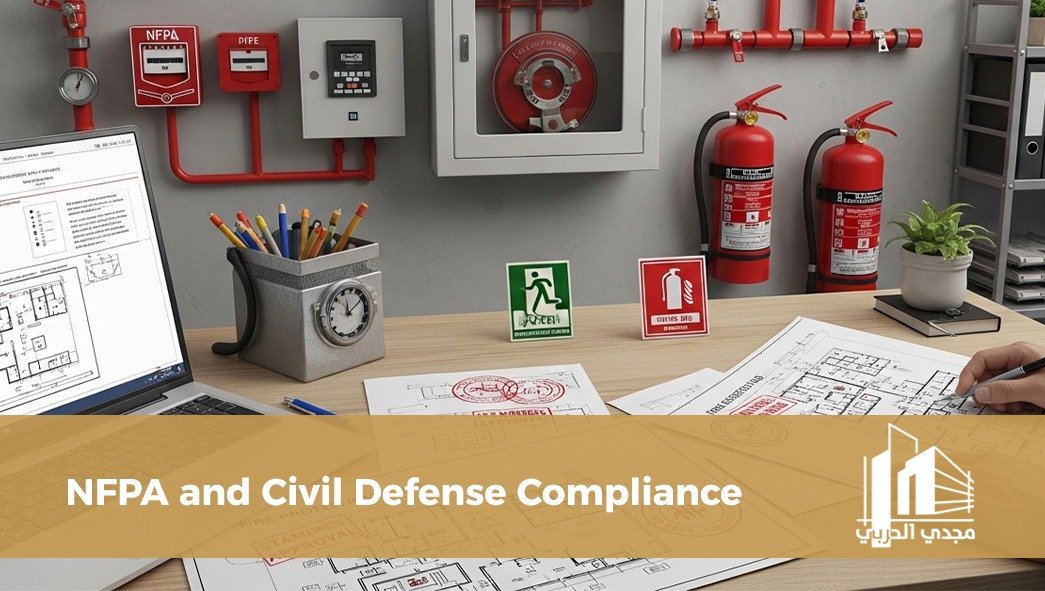
Have you ever wondered, while walking through a shopping mall, why those green emergency exit signs are installed everywhere?
You may pass by them every day without paying attention, assuming they are merely a routine government requirement or a Civil Defense condition that must be met to obtain a license.
However, the deeper truth is that behind every green sign, every fire extinguisher mounted on a wall, and every sprinkler head installed in the ceiling, there are real stories of fires that actually occurred. Some ended with material losses, while others—God forbid—resulted in lives that could have been saved.
Over decades, these incidents evolved into a precise body of science and engineering known as NFPA standards (National Fire Protection Association). These standards were later adapted to suit the local environment through the Saudi Fire Code and Civil Defense regulations.
Compliance with these standards is not merely a formal procedure. It is a real guarantee that your facility—whether a residential villa or a commercial tower—is capable of protecting its occupants.
What Does Compliance with NFPA Standards Mean?
Compliance means the systematic and precise adherence to a set of technical rules and legal regulations that ensure a facility is designed and implemented according to the highest safety standards.
Compliance with NFPA standards: This refers to following the technical codes issued by the National Fire Protection Association, which define hydraulic calculations for sprinkler systems, sensor placement, and material compatibility. These standards ensure that fire protection systems will operate with full physical efficiency during a fire emergency.
Compliance with Civil Defense requirements: This refers to aligning these technical standards with local regulations in Saudi Arabia, submitting plans through the Salamah platform, and using materials approved by the Saudi Standards, Metrology and Quality Organization (SASO) to obtain occupancy certificates and legal operating permits.
What Are NFPA Standards and Why Are They Global?
The National Fire Protection Association (NFPA) is considered the world’s leading reference for engineering safety. Its experts have developed thousands of codes and standards that cover every detail within a building—from sprinkler distribution methods to fire-resistant electrical wiring.
NFPA 13
The global standard for the design and installation of fire sprinkler systems.
NFPA 72
The National Fire Alarm and Signaling Code, governing fire detection and alarm systems.
NFPA 101
The Life Safety Code, focusing on protecting building occupants and ensuring safe emergency exits.
The Difference Between NFPA Standards, the Saudi Building Code, and Civil Defense Requirements
There is often confusion between international standards and local regulations in the field of fire protection systems. In reality, each has a distinct yet complementary role aimed at achieving safety and regulatory compliance within the Kingdom.
Technical Reference
NFPA standards serve as a technical guide detailing how fire suppression and alarm systems should be designed and implemented, including hydraulic calculations, flow rates, and installation criteria.
Local requirements, on the other hand, specify what must be provided in a building based on the nature of the activity and approved safety requirements in Saudi Arabia.
Regulatory Framework
The Saudi Building Code (SBC)—particularly the Saudi Fire Code (SBC 801)—acts as the legal framework that adopts global best practices. It frequently references NFPA standards to ensure correct engineering implementation of fire protection systems.
Localization and Adaptation
The Saudi Building Code adapts NFPA standards to align with the local environment, climate, and professional requirements within the Kingdom, as well as integration with the Salamah platform and local infrastructure.
Legal Obligation
Compliance with NFPA standards reflects high engineering quality according to global best practices. However, compliance with Civil Defense requirements and the Saudi Building Code is a legal requirement to obtain official permits and operate facilities within the Kingdom.
What Are Saudi Civil Defense Requirements?
Saudi Civil Defense regulations represent the mandatory regulatory framework defining the minimum safety requirements that must be met in all facilities within the Kingdom.
These requirements extend beyond installing fire systems and involve a complete cycle beginning at the design stage and continuing through operation and maintenance, including:
Approval of engineering drawings through the Salamah platform before implementation, ensuring they are prepared by a licensed consulting office and comply with the Saudi Building Code.
Accurate classification of hazard levels (light, ordinary, or high hazard), which determines the required fire suppression systems, water tank capacities, and fire pump specifications.
Use of certified equipment and systems with international approvals such as UL or FM, as well as local approval from SASO.
Execution by licensed fire protection contractors to ensure compliance with approved technical specifications.
Testing and commissioning procedures before issuing occupancy certificates to confirm system readiness under real operating conditions.
Periodic maintenance contracts with certified companies and submission of inspection reports through the Salamah platform to maintain license validity.
How Does Non-Compliance Affect Facility Protection?
Underestimating safety standards or treating them as mere paperwork exposes a facility to serious risks beyond financial penalties.
System failure during emergencies: Failure to comply with NFPA standards may result in fire pumps not delivering sufficient pressure or sprinklers failing to cover the required area, allowing a fire to spread within minutes.
Loss of insurance coverage: Insurance companies carefully review safety certificates. If a fire occurs and non-compliance is proven, insurers may refuse compensation, leading to significant financial losses.
Criminal and civil liability: In case of injuries or fatalities—God forbid—the facility owner and responsible parties may face severe legal consequences due to negligence in applying the Saudi Building Code and Civil Defense requirements.
Operational disruption: Non-compliance can lead to rejection of licenses or administrative closure of the facility, resulting in operational downtime and reputational damage in the market.
Steps to Achieve Full Compliance in Your Project
To ensure that your facility fully meets engineering safety standards, the following methodology should be followed:
1. Engineering Review of Drawings
The process begins by reviewing architectural and mechanical drawings to ensure they do not conflict with escape routes or fire suppression system layouts according to the adopted NFPA codes.
2. Selection of Approved Materials (Listed & Approved)
In fire protection systems, not every material can be used. Fire pumps, sprinklers, and smoke detectors must carry international certifications such as UL or FM, and must also be approved locally by SASO.
3. Supervision of Implementation
An error in installing a single valve may disrupt an entire suppression system. Therefore, field supervision ensures the contractor adheres to the required technical distances, pressures, and installation standards.
Compliance Challenges and How to Overcome Them
Random Interior Design Modifications
Decorative installations may hide sprinkler heads or obstruct smoke detectors.
Solution: early coordination between interior designers and fire safety engineers.
Use of Non-Approved Materials
Some projects attempt to use materials lacking UL/FM certifications or SASO approval.
Solution: verify material certifications before procurement.
Neglecting Maintenance
Installing a system without maintaining it renders it ineffective.
Solution: contract with a licensed maintenance company to ensure continuous readiness.
The Role of the Engineering Consultant in Achieving Integrated Safety
True compliance cannot be achieved without a specialized engineering consultant. The consultant serves as the essential link that ensures:
Engineering solutions: designing systems compatible with the building layout without compromising aesthetics while maintaining technical efficiency.
Owner protection: monitoring contractor work quality and preventing financial losses caused by technical mistakes.
Regulatory responsibility: acting as the authorized entity responsible for submitting drawings through the Salamah platform.
System integration: ensuring fire alarm, suppression, and ventilation systems operate in full coordination during emergencies.
Why Majdi Al-Harbi Is Your Compliance Partner
Achieving compliance with NFPA standards and Civil Defense regulations requires deep expertise and continuous coordination with regulatory authorities. At Majdi Al-Harbi Engineering & Safety Consultancy, we provide:
Plan approval services: reviewing and approving fire safety designs with high precision to ensure acceptance on the Salamah platform.
NFPA consultancy: our team includes specialists familiar with detailed international codes to provide innovative and cost-effective engineering solutions.
Technical condition reports: inspecting existing facilities and providing reports that evaluate compliance levels and recommend corrective actions.
Protecting facilities from fire begins with adhering to safety standards, and success lies in choosing the right engineering partner who can turn those standards into a safe reality.
Are you ready to secure your facility according to the highest safety standards? Contact us now to ensure full compliance and comprehensive protection.
Frequently Asked Questions
Does the Saudi Building Code replace the need to refer to NFPA standards?
In fact, the Saudi Building Code—especially SBC 801—relies heavily on NFPA standards and references them in many technical aspects.
What are the penalties for non-compliance with Civil Defense requirements?
Penalties may include significant financial fines, administrative closure of the facility, or refusal by insurance companies to cover incidents occurring in non-compliant locations.