
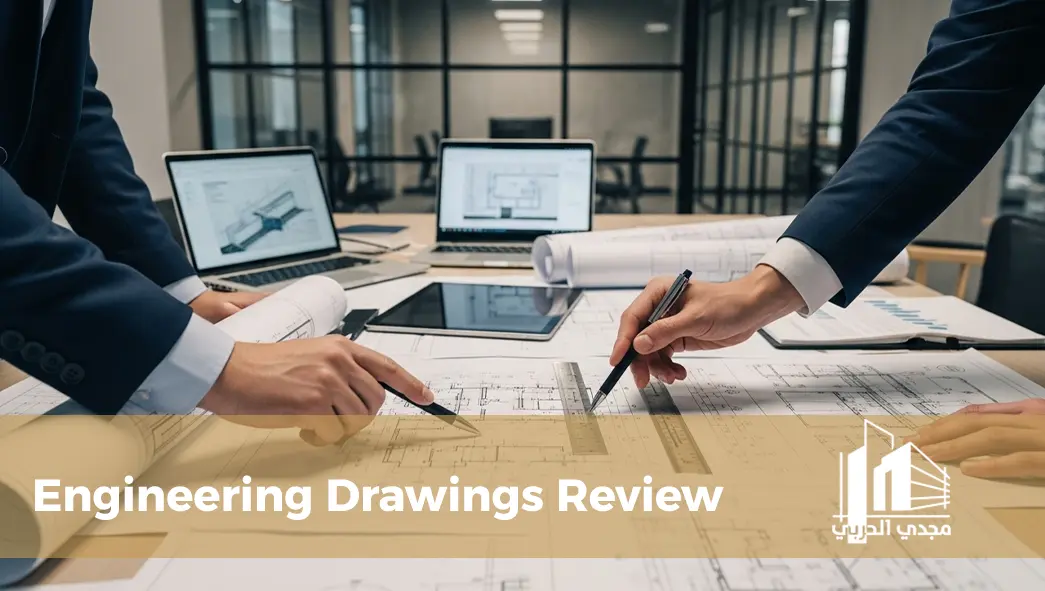
Imagine that a minor mistake in column distribution or building height could delay project delivery by three months and increase costs by SAR 150,000. That’s why reviewing engineering drawings is not merely a routine step—it is a strategic process that protects your investment and ensures project quality from the outset.
Through thorough auditing, you can detect errors before construction begins, ensure that technical specifications align with real-world conditions, and achieve a practical, buildable design without costly surprises. In this guide, we cover everything you need to know about reviewing and auditing engineering drawings—from design stages and engineering project planning to best practices that ensure quality and accuracy.
Why Is Reviewing Engineering Drawings Essential?
Many projects encounter problems due to drawings that were not properly reviewed before execution. Any design error can lead to costly modifications, schedule delays, or quality issues.
The primary objective of drawing review is to identify potential errors early—whether technical, design-related, or regulatory. This includes verifying compliance with approved engineering specifications and ensuring constructability on-site.
Drawing audits also ensure compliance with Saudi laws and standards, facilitating approvals from regulatory authorities and reducing the likelihood of rejection or costly revisions after construction begins.
Moreover, the review process supports effective planning across all project stages—from selecting appropriate materials and organizing timelines to accurately estimating costs. This strengthens engineering project planning and places the project on a secure path from the beginning.
Common Mistakes Without Proper Drawing Review
Neglecting drawing audits often leads to costly issues, including:
Inaccurate dimensions or details: Incorrect levels or space allocations that require later modifications.
Conflicts between drawings: Discrepancies between architectural, structural, and electrical plans causing stoppages and delays.
Unclear or non-compliant specifications: Poorly defined specifications leading to unsuitable material selection or substandard execution.
Non-compliance with the Saudi Building Code: Resulting in regulatory rejection or costly post-construction modifications.
Avoiding these mistakes through comprehensive engineering drawing review ensures full project control before moving into execution.
Practical Example: In one residential project, failure to thoroughly review electrical layouts resulted in complete rewiring after construction had started, increasing costs by 12% and delaying delivery by two weeks.
The Role of Engineering Audit in Protecting Your Project
Engineering auditing is an in-depth analytical process that examines every drawing component to ensure alignment with project requirements.
Key functions of auditing include:
Early detection of technical errors: Consultants carefully examine drawings to eliminate contradictions or design flaws.
Constructability analysis: Ensuring the design can be implemented on-site without later modifications.
Specification verification: Confirming all elements comply with engineering standards.
Coordination across disciplines: Ensuring architectural, structural, and MEP systems are fully integrated to avoid unexpected adjustments.
Modern tools such as BIM and AutoCAD can be used to digitally review drawings, increasing precision and minimizing human error.
This makes auditing an essential component of engineering project planning, ensuring efficient and high-quality execution without unwanted surprises.
Design Stages and Their Importance in Drawing Review
Engineering drawing review should cover all design phases:
1. Conceptual Stage
Defining project vision and objectives, conducting site studies, and analyzing the surrounding environment to determine spatial requirements and general functions.
2. Detailed Design Stage
Including architectural, structural, electrical, and mechanical details. This phase requires high-level auditing to ensure full technical coordination.
3. Construction Stage
Final drawings submitted to contractors and authorities must be error-free and ready for immediate implementation.
Practical Example: Proper selection of concrete type and wall thickness during detailed design reduces cracking and material waste during construction and ensures compliance with Saudi standards.
Reviewing each stage prevents minor issues from escalating into major execution problems and enhances overall project planning efficiency.
How Auditing Improves Project Quality
Drawing audits enhance project quality in several ways:
Verifying precise details such as dimensions, connections, materials, and execution methods.
Ensuring full compliance with engineering specifications.
Identifying required modifications before reaching the construction site.
Documenting findings and recommendations through clear, actionable reports.
This process minimizes financial waste and time loss while ensuring your project is delivered at the highest quality standards with fewer unexpected challenges.
Choosing the Right Firm for Drawing Review & Audit
When selecting an engineering firm for drawing review, ensure the following:
Official accreditation: Approval by the Saudi Council of Engineers to guarantee compliance with professional standards.
Proven experience: A track record in similar residential or commercial projects.
Multidisciplinary team: Architectural, structural, and MEP engineers for comprehensive review.
Clear reporting: Detailed reports outlining identified issues, recommended modifications, and execution plans.
Choosing the right firm ensures drawings are fully ready for execution, reducing technical and financial risks.
Why Choose Engineer Majdi Al-Harbi Company?
Engineer Majdi Al-Harbi Company is your optimal partner for engineering drawing review and auditing, offering:
Extensive experience across all design phases and project types (residential and commercial).
A specialized team ensuring compliance with engineering specifications and Saudi standards.
Detailed and comprehensive reports enabling confident decision-making before execution.
Full commitment to engineering project planning principles to guarantee success and prevent future errors.
Choosing Engineer Majdi Al-Harbi Company means placing your project in safe hands—achieving high quality while minimizing risks and potential costs.
Frequently Asked Questions
Do all projects require engineering drawing review?
Yes. Regardless of project size, auditing reduces risks and saves time and cost.
Can drawings be modified after review?
Yes. The purpose of the review is to identify necessary adjustments before construction begins.
What is the difference between design and auditing?
Design creates the plans, while auditing verifies their accuracy and feasibility before execution.
Does the review differ between residential and commercial projects?
Yes. Requirements for utilities, space planning, and materials vary depending on project type.
Conclusion
Reviewing and auditing engineering drawings is a critical step in any successful project. Protect your investment, enhance execution quality, and avoid costly surprises.
Contact Engineer Majdi Al-Harbi Company today and let our experts ensure precise drawings and high-quality execution—from concept to final handover.