
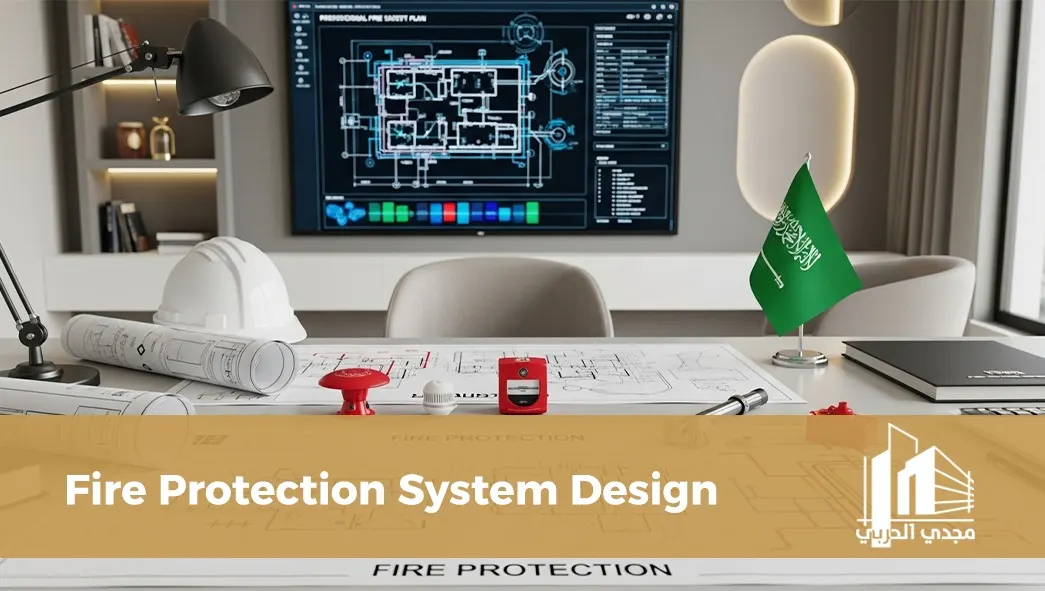
Are you sure your building is truly protected? Not because of negligence, but because the concept of safety has evolved significantly in recent years. In a world where risks are constantly increasing, simply placing a fire extinguisher in a distant corner is no longer enough.
Real protection begins the moment the engineer puts pen to paper—inside the design office, long before construction begins. It is a complex equation that combines physics, engineering, and an understanding of human behavior during moments of fear. Its ultimate goal is to give you enough time to make the right decision when seconds are burning away.
In this article, we will discuss the importance of engineering safety design, and how advanced systems help reduce risks while ensuring full compliance with the requirements of the Saudi Civil Defense.
What Are Fire Protection Systems?
Fire protection systems are an integrated set of engineering and technical measures designed to protect buildings and their occupants through three main functions: detection, control, and suppression.
These systems are not limited to manual fire extinguishers. They include sophisticated engineering solutions that operate together in full coordination to provide the highest level of safety.
The primary objective of these systems is to prevent fires from occurring in the first place. If a fire does occur, the system works to confine it within the smallest possible area while providing safe evacuation routes, thereby reducing the likelihood of severe human or material losses.
The Role of Engineering Safety Design in Reducing Fire Risks
Engineering safety design plays a critical role in minimizing the likelihood of disasters and controlling them once they occur. Professional design does not focus solely on installing equipment; it emphasizes prevention and containment strategies through:
Risk Analysis and Fire Load Assessment
Studying the nature of activities inside the building and the materials stored within it to estimate the potential risk level, which helps determine the most effective fire suppression system.
Smart Planning of Escape Routes
Designing evacuation corridors and emergency exits to be the shortest and safest paths while ensuring they are protected from smoke and heat infiltration.
Fire Compartmentation
Designing buildings with fire-resistant sections to prevent the spread of fire from one floor to another or from one area to another, giving firefighting teams more time to control the situation.
Integration of Smart Systems
Connecting fire detectors with elevators, HVAC systems, and ventilation systems so that airflow feeding the fire is stopped and elevators are automatically directed to the ground floor once danger is detected.
Saudi Civil Defense Requirements for Fire Protection Systems
The General Directorate of Civil Defense establishes strict standards to ensure the safety of facilities. These regulations serve as the primary reference for any construction project in the Kingdom.
The key requirements include:
Prior Approval of Safety Drawings
Fire and safety drawings must be designed and approved by a licensed engineering consultancy office accredited by Civil Defense, ensuring compliance with the Saudi Building Code (SBC 801).
Registration on the Salama Platform
Business owners must issue and renew safety permits electronically through the Salama platform, which connects facilities directly with Civil Defense safety requirements.
Safety Equipment Certification
Facilities must contract with an approved installation and maintenance company to install safety systems and issue a certificate confirming that the equipment complies with Saudi Standards, Metrology and Quality Organization (SASO) specifications.
Periodic Safety Records
A documented safety log must be maintained to confirm regular inspections of alarm and firefighting systems, ensuring that fire pumps and other equipment operate effectively in emergencies.
Emergency Signage Distribution
Installation of illuminated emergency exit signs and evacuation route indicators, as well as clear identification of safe assembly points.
Components of Modern Fire Protection Systems
The effectiveness of a fire protection system relies on the integration of three main components carefully defined during the design phase.
First: Early Fire Detection Systems
The early fire detection system acts as the brain of the entire safety network. Its importance lies in reducing the time between fire ignition and evacuation response.
It typically includes:
Smoke Detectors
Operate using optical or ionization technologies to detect smoke particles in their early stages.
Heat Detectors
Used in areas where normal smoke may exist (such as kitchens) and designed to detect abnormal temperature increases.
Control Panels
The central unit that receives signals from detectors and processes them to activate alerts.
Civil Defense Communication Systems
Automatic alert transmission to relevant authorities to ensure rapid emergency response.
Second: Advanced Fire Suppression Systems
Fire suppression systems are selected based on the nature of the facility’s activities and may include:
Automatic Sprinkler Systems
A network of pipes that automatically releases water when a certain temperature is reached to extinguish the fire.
Gas Fire Suppression Systems (FM200 and CO₂)
Used in sensitive areas such as server rooms because they extinguish fires without causing material damage.
Foam Fire Suppression Systems
Highly effective for fires involving flammable liquids and chemical storage facilities.
Fire Hose Reel Systems and Fire Cabinets
Provide a quick manual intervention method for building occupants at the early stages of a fire.
Third: Smoke Control and Emergency Ventilation Systems
Smoke is the leading cause of fire-related fatalities, which highlights the importance of mechanical smoke control systems.
Smoke Extraction Fans
Remove toxic gases and heat from the building to the outside.
Staircase Pressurization Systems
Supply clean air into stairwells to prevent smoke infiltration.
Natural Ventilation Openings
Strategically placed openings that allow smoke to escape naturally.
Why Do You Need a Consulting Office to Design Safety Systems?
The role of a consulting engineering office ensures:
Cost Optimization
Selecting the most appropriate systems at the best cost without unnecessary over-specification.
Regulatory Approval
Ensuring that safety drawings are approved quickly through the Salama platform.
Professional Supervision
Ensuring that contractors install safety systems according to the highest quality standards.
Investing in fire protection systems is not an additional expense; it is a guarantee of business continuity and protection of your assets.
At Majdi Al-Harbi Engineering and Safety Consultancy, we combine extensive experience with strict adherence to national standards to deliver engineering designs that ensure the complete safety of your facility.
Are you looking for fire protection system designs that comply with the latest codes? Contact us today to discuss your project.
Frequently Asked Questions About Fire Protection Systems
How long does it take to approve fire safety drawings?
The timeframe depends on the size of the project, but with an experienced consultancy office, the procedures through the Salama platform can be completed in a short time.
How is system efficiency verified after installation?
This is done through commissioning tests, where the system is activated, all sensors are tested, and signal transmission to the control panel is verified successfully.