
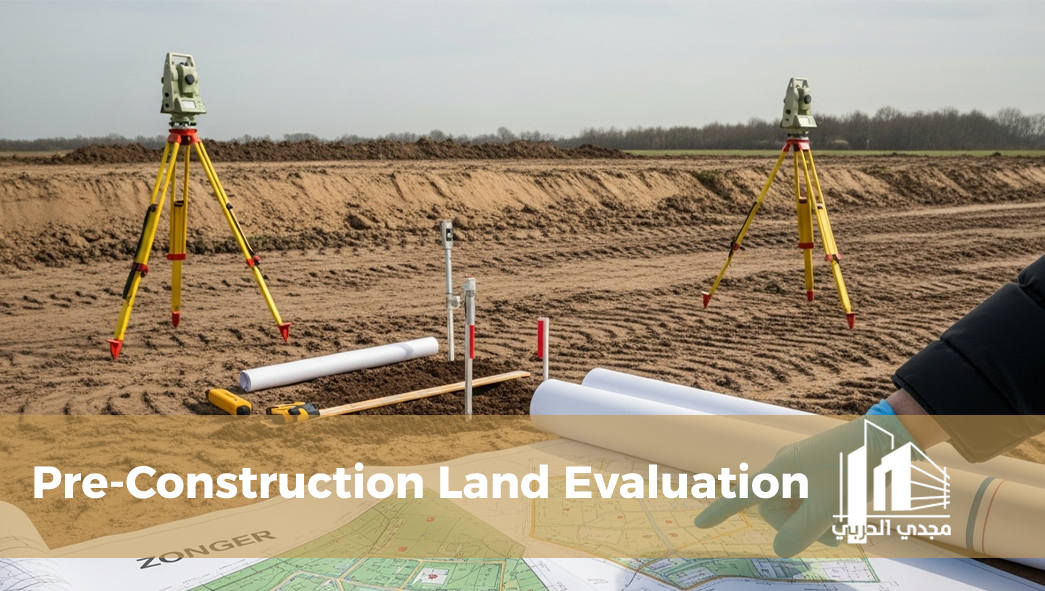
Before starting any construction project, there is a critical decision that can determine its success or failure from the very beginning: choosing the right land and understanding its characteristics accurately. Many issues that appear later in buildings are not caused by design or execution, but by neglecting the land evaluation stage. This stage is not a formal procedure; it is a fundamental technical step that protects your investment from hidden risks that may only appear after work begins.
In this article, we review the importance of land evaluation in Saudi Arabia, the role of site studies, soil testing, and property evaluation in ensuring project safety and stability, and the best practices that help you make informed decisions before laying the first stone.
Why Is Land Evaluation Essential Before Construction?
Land evaluation represents the first step in understanding the nature of the site where the project will be built. Land is not just an empty space; it is an environment with geological and hydrological characteristics that directly affect foundation types, construction methods, and long-term project costs.
Neglecting this stage may lead to selecting land that is unsuitable for the planned building, forcing costly engineering solutions or complex design modifications later. Some sites may contain weak soil layers or high groundwater levels, which can threaten structural stability if not identified early.
Early evaluation acts as a preventive measure that protects the project from structural risks and helps establish a realistic understanding of construction costs and foundation requirements.
Site Study: The First Reading of the Land
The site study is the first analytical step in the land evaluation process and aims to understand the general characteristics of the location before conducting specialized technical tests. This study includes analyzing the land’s relation to surrounding infrastructure, terrain conditions, slope levels, and proximity to water sources or drainage areas.
It also involves reviewing the land’s previous use and identifying whether filling or land reclamation activities have taken place, which may affect soil behavior under structural loads. Studying the surrounding environment also helps determine regulatory restrictions, service routes, and the requirements of official authorities before finalizing the project design.
This stage provides a comprehensive overview of the site and supports an initial decision about its suitability for the planned project.
Soil Testing: The Scientific Basis for Structural Safety
Soil testing is one of the most critical stages of land evaluation because it reveals the physical and mechanical properties that determine the soil’s ability to bear loads. Through these tests, specialists determine soil type, cohesion level, moisture content, and the depth of layers suitable for foundation work.
Test results help engineers select the appropriate foundation type, whether shallow or deep, determine safe excavation depths, and define the required concrete specifications. Soil tests can also reveal potential problems such as expansive or compressible soils, which may cause uneven settlement if not properly addressed.
Conducting soil tests at the right time reduces unexpected issues during construction and provides designers with accurate data for stable and safe structural solutions.
Geological Reports and Their Role in Reducing Structural Risks
Land evaluation is not complete without comprehensive geological reports that describe soil layers, rock formations, and groundwater levels. These reports serve as the primary technical reference for all design and construction decisions related to foundations, excavation, and temporary support systems.
Through geological analysis, experts can predict how the ground will behave under long-term loads and assess the possibility of landslides, settlement, or seismic effects in certain regions. These reports also help determine necessary precautions during excavation and avoid problems related to water leakage or weak soil cohesion.
Reliable geological reports reduce hidden risks that may not appear until after construction is completed.
Property Evaluation: The Technical and Investment Perspective
Property evaluation does not only determine the market value of the land; it also assesses its technical suitability for the intended project. Some lands may have high commercial value but require complex engineering solutions that significantly increase construction costs.
Through this evaluation, the technical characteristics of the land are linked with the expected investment return, considering foundation costs, soil treatment work, and infrastructure requirements. This analysis helps investors and project owners make balanced decisions between land price, risks, and financial feasibility.
A comprehensive evaluation prevents purchasing land that appears suitable on the surface but carries hidden construction challenges.
When Do You Need Engineering Consultation?
During the land evaluation stage, specialized engineering consultations play a key role in interpreting test results and transforming technical data into practical decisions. Reports alone are not sufficient unless they are analyzed within the context of the project design, type, and operational requirements.
An engineering consultant can help with:
Selecting the appropriate testing program for the site conditions.
Interpreting soil and geological test results accurately.
Proposing safe and cost-effective structural solutions.
Coordinating with designers and official authorities to approve results.
Engaging experts at this stage reduces early risks and builds a solid foundation for all subsequent project phases.
Best Practices for Successful Land Evaluation Before Construction
To achieve the maximum benefit from the evaluation stage, it is recommended to follow several professional practices:
Conduct a site study before purchasing the land or approving the final design.
Perform soil testing at multiple points to ensure accurate site representation.
Prepare geological reports approved by specialized authorities.
Review evaluation results within a multidisciplinary team.
Document all technical data for use during design and construction stages.
Following these steps reduces unexpected challenges and improves the accuracy of engineering decisions from the beginning.
Why Choose Engineer Magdy Al-Harbi Company
Engineer Magdy Al-Harbi Company provides specialized services in land evaluation, soil studies, and geological analysis, focusing on linking technical assessments with practical engineering solutions.
The team is distinguished by:
Extensive experience across various locations in Saudi Arabia.
Accurate reports that support foundation and design decisions.
Integrated analysis combining technical and investment perspectives.
Continuous follow-up to ensure compliance with official authority requirements.
Choosing Engineer Magdy Al-Harbi Company gives you a clear understanding of your land’s characteristics and ensures a safe engineering foundation for your project from the very beginning.
Frequently Asked Questions
Can construction start without evaluating the land?
It may be possible procedurally, but it exposes the project to significant structural risks and unexpected costs.
What is the difference between a site study and soil testing?
A site study analyzes the general characteristics of the location, while soil testing is a technical examination that determines the land’s load-bearing capacity.
Does property evaluation include structural considerations?
Yes, it includes assessing technical suitability in addition to the investment value.
When should land evaluation be conducted?
It is best performed before purchasing the land or approving the final design to ensure informed decision-making from the start.
Conclusion
Land evaluation is the first and most critical step in the journey of any successful construction project in Saudi Arabia. From site studies and soil testing to geological reports and property evaluation, each stage contributes to building a stable, safe, and economically viable project.
Investing in this stage does not only protect your project but also saves significant costs and prevents risks that may appear later during construction.
Contact Engineer Magdy Al-Harbi Company today to request a specialized consultation and ensure the right land choice and a strong start for your project.