
Have you ever experienced the moment when an alarm siren suddenly sounds inside a public facility? In those few seconds, curiosity mixes with fear, and questions quickly arise: Is it real? Where is the danger?
What should I do now? Yet the most important truth many people may not know is that modern fire alarm systems today are designed to prevent you from reaching that moment in the first place.
The goal is no longer just to trigger a loud alarm after it is too late; instead, it has become an intelligent system operating silently behind the walls—monitoring, analyzing, and making decisions.
It is the difference between a traditional system that waits until smoke appears before sounding the alarm, and an advanced engineering design capable of detecting early warning signs in the air and suppressing the fire at its earliest stage. In this way, the sound of the alarm remains only a story told, not an experience lived.
In this article, we will explore the types of modern fire detection devices, the importance of early fire detection systems, and how the integration of building engineering systems achieves the highest levels of safety in accordance with the Saudi Building Code.
What Are Fire Alarm Systems?
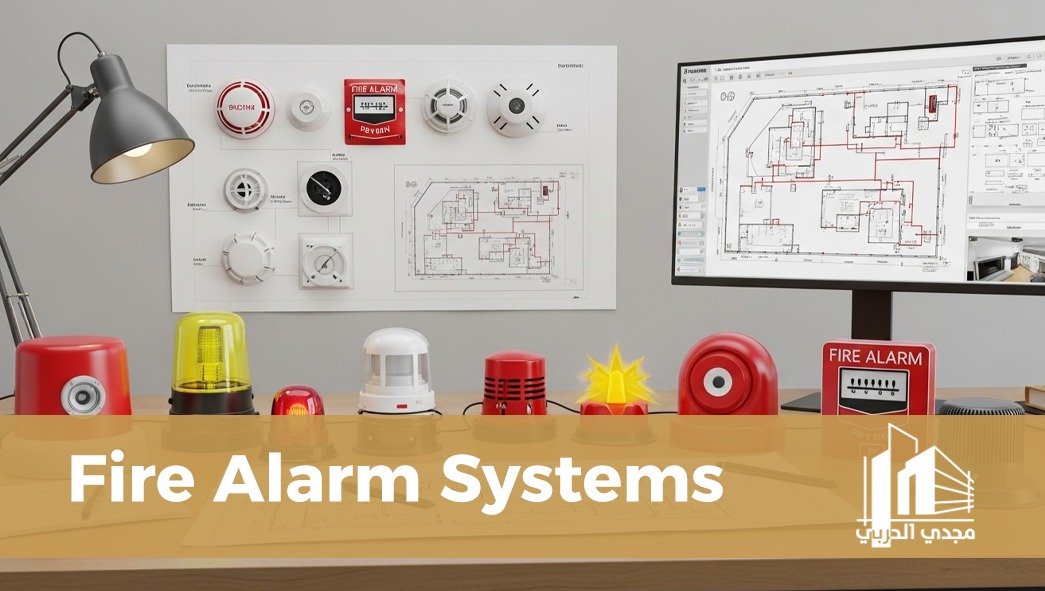
Fire alarm systems are defined as technical systems that continuously monitor the building environment around the clock. Their operation begins when fire detectors send a signal to the main fire alarm control panel (FACP). The panel then analyzes the received data and activates notification appliances such as alarms, flash lights, or voice messages. In some cases, it may also activate automatic fire suppression systems, which operate through the following stages:
Detection: Monitoring smoke or heat through connected sensors.
Activation: The control panel opens the main valves to start discharging the extinguishing agent.
Suppression: The extinguishing agent (water, clean gas, or foam) is released directly over the hazard area.
Importance of Early Fire Detection Systems
The philosophy behind early fire detection is to identify the initial indicators of fire—such as microscopic smoke particles or slight temperature increases—before visible flames appear. These critical seconds can significantly contribute to:
Reducing human casualties: by providing building occupants sufficient time for organized evacuation.
Immediate response: by sending signals to firefighting units or activating automatic suppression systems at the earliest stage.
Asset protection: controlling the fire during its incipient stage prevents damage to sensitive equipment and critical infrastructure.
Difference Between Conventional and Addressable Systems
When designing fire safety systems, a common question arises regarding the difference between conventional fire alarm systems and addressable systems. The following comparison clarifies which system may be most suitable for your facility:
| Comparison Aspect | Conventional System | Addressable System |
|---|---|---|
| Location Identification | Identifies only the zone without pinpointing the exact room. | Identifies the precise location of each detector (e.g., Detector 15 – Manager’s Office). |
| Wiring | Requires separate wiring for each zone. | Uses a loop system, reducing the amount of wiring. |
| False Alarms | More susceptible to false alarms and difficult troubleshooting. | Highly intelligent; can distinguish between dust and actual smoke. |
| Cost | Lower device cost but higher installation and wiring costs. | Higher device cost but more efficient installation and maintenance. |
| Suitable Facilities | Small buildings, shops, and simple warehouses. | High-rise towers, hospitals, hotels, and large complexes. |
Types of Fire Detection Devices and Their Technical Functions
The effectiveness of a fire alarm system largely depends on selecting the appropriate fire detection devices for the specific environment:
Smoke Detectors: Include photoelectric detectors and highly sensitive air-sampling smoke detection systems used in critical areas such as server rooms.
Heat Detectors: Commonly used in kitchens and industrial facilities to avoid false alarms caused by natural vapors.
Flame Detectors: Detect radiation emitted directly from flames and are typically used in high-risk open areas.
Gas Detectors: Detect leaks of flammable or toxic gases, providing early warning before a fire occurs.
Integration of Fire Alarm Systems with Other Building Systems
The true distinction of modern safety design lies in the integration of engineering systems within the building. When a fire alarm signal is triggered, the integrated system automatically performs several coordinated actions:
HVAC management: shutting down air-conditioning fans and activating smoke extraction systems.
Elevator control: directing all elevators to the ground floor and automatically opening their doors.
Access control: releasing magnetic doors to ensure smooth evacuation.
Voice evacuation: broadcasting intelligent voice guidance messages.
Mistakes That Reduce Fire Alarm System Efficiency
Even with advanced equipment, a fire alarm system may fail to perform effectively due to common design or installation errors, including:
Improper detector placement: installing detectors far from airflow paths or behind structural barriers, delaying smoke detection.
Neglecting periodic maintenance: dust accumulation on sensors weakens their response or causes repeated false alarms that may lead occupants to ignore real alarms.
Detector-environment mismatch: installing smoke detectors in areas with cooking fumes or heavy dust, or installing heat detectors in large spaces where heat does not concentrate quickly.
Insufficient sound coverage: failing to distribute alarm sounders properly to ensure they are audible throughout all rooms and facilities, particularly in noisy environments.
Architectural modifications after installation: making changes to partitions or false ceilings without adjusting detector locations to match the new building layout.
Why Do You Need an Engineering Consultation to Design the System?
Designing fire alarm systems requires professional engineering expertise to ensure:
Comprehensive coverage: eliminating blind spots within the facility.
Technical accuracy: selecting the most suitable system (conventional or addressable) based on your budget and operational needs.
Regulatory compliance: ensuring designs comply with the Salamah platform requirements and the Saudi Building Code.
At Majdi Al-Harbi Engineering & Safety Consultancy, we provide designs that meet the highest international and local safety standards.
Would you like to obtain a technical study for the fire alarm system in your project? Contact us now for a specialized consultation.
(FAQ) About Fire Alarm Systems
What are the key Saudi Building Code requirements for fire alarm systems?
The Saudi Building Code (SBC) requires that fire protection drawings be prepared and approved by licensed engineering offices. Equipment and materials must comply with Saudi standards (SASO). Large and commercial buildings must use addressable control panels capable of integrating with other safety systems.
Is a fire alarm system mandatory to obtain Civil Defense licensing?
Yes. A functional and tested fire alarm system is a fundamental requirement for obtaining or renewing Civil Defense permits through the Salamah platform. A safety certificate is issued only after submitting a technical report from an approved company confirming system readiness.
How can false alarms be reduced in facilities?
False alarms can be minimized by selecting the appropriate detector type. For example, smoke detectors should not be installed in kitchens and should be replaced with heat detectors. Regular maintenance and cleaning sensors from dust also play a key role in maintaining system stability.
What is the cost difference between addressable and conventional systems?
Conventional systems have lower equipment costs (detectors and control panels), but installation and wiring may be more expensive. Addressable systems are often a better investment for large buildings because they reduce cabling, simplify maintenance, and allow precise fault identification, which saves costs in the long term.
Do fire alarm systems require periodic replacement or upgrades?
The typical lifespan of most fire detectors ranges between 8 to 10 years. However, control panels and backup batteries may require replacement or upgrades more frequently—usually every 2 to 4 years—to ensure system operation during power outages.
How is the fire alarm system connected to the Salamah platform?
The process is administrative: the engineering consultant uploads the approved drawings, while the certified maintenance company submits periodic inspection reports on the platform. This enables Civil Defense to automatically verify the facility’s safety status without frequent on-site inspections.
What happens if the main fire alarm control panel fails?
If the control panel fails, the building loses its automatic fire detection capability. Therefore, the system must include a Trouble Signal that immediately alerts users when a fault occurs. A qualified technician must be called immediately for repair, while manual monitoring is intensified until the system is restored.