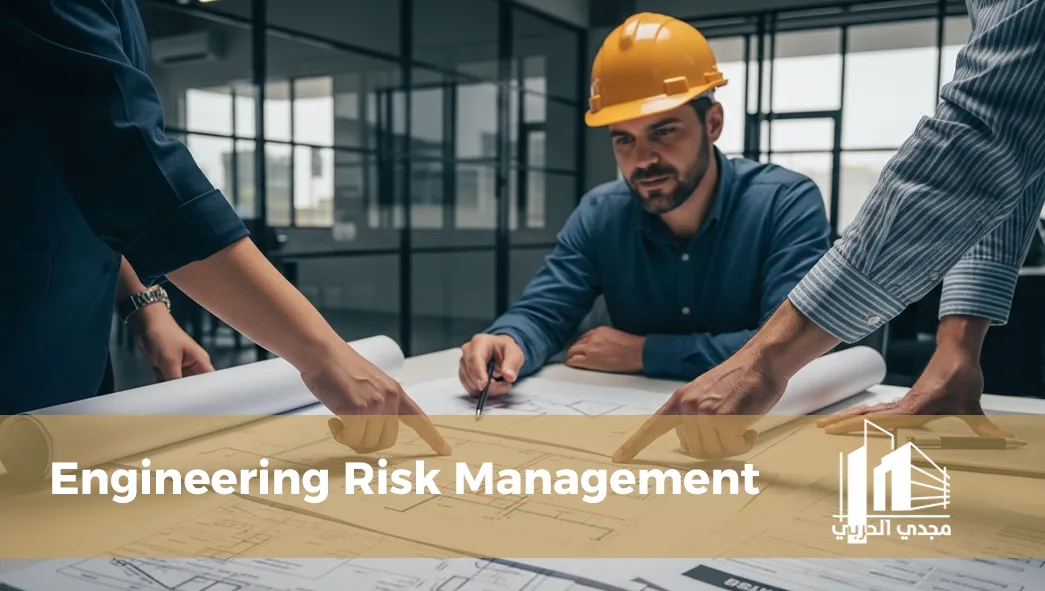
Major engineering projects transition from paper-based plans into tangible realities through a complex chain of processes. At every stage of this journey, challenges may arise that impact timelines, costs, or even the safety of structures and human lives. Here, Engineering Risk Management emerges as a fundamental system that ensures projects are executed in accordance with technical specifications while meeting international safety standards and the Saudi Building Code.
Concept of Engineering Risk Management
Engineering Risk Management is a systematic process aimed at identifying, analyzing, evaluating, and mitigating potential risks that could negatively affect the success of engineering projects—whether in terms of cost, schedule, quality, or safety.
It involves assessing financial, environmental, and technical threats, and developing proactive strategies to avoid or reduce their impact throughout the entire project lifecycle.
How Does Risk Management Protect a Project?
Risk management serves as the project’s protective shield through its direct impact on three critical levels:
Protection of Assets and Investments: By anticipating structural failures or fire hazards before they occur, engineering risk management prevents damages that could cost millions, thereby preserving the capital value of the facility.
Ensuring Schedule Continuity: Most delays in large-scale projects stem from unforeseen technical or legal complications. A proactive plan enables a prepared response, minimizing downtime and preventing workflow disruptions.
Compliance and Professional Reputation: Protecting the project from legal consequences and penalties due to non-compliance with engineering codes enhances stakeholder confidence and reinforces the credibility of your engineering outputs.
Classification of Engineering Risks
Understanding how to safeguard projects begins with identifying the nature of potential risks, which generally fall into several core categories:
Technical and Design Risks: Errors in structural calculations, unsuitable soil conditions, or the use of non-compliant construction materials.
Safety and Fire Protection Risks: Deficiencies in alarm and suppression systems, or poor emergency exit distribution, increasing the likelihood of casualties and property loss in the event of a fire.
Environmental and Natural Risks: Earthquakes, floods, or extreme climate variations that may affect structural integrity if not considered during analysis and design phases.
Legal and Contractual Risks: Non-compliance with municipal regulations or updates to the Saudi Building Code (SBC), potentially resulting in project suspension or substantial fines.
Operational Risks: Issues arising after project handover, such as mechanical or electrical system failures due to inadequate maintenance planning.
Strategic Pillars for Enhancing Engineering Project Safety
To establish a comprehensive protection framework, modern engineering practices rely on three core pillars that form the backbone of risk management:
1. Risk Assessment During the Design Phase
Safety management begins at the engineering desk—well before the foundation stone is laid. A design that accurately distributes loads, ensures compatibility between materials and environmental conditions, and integrates fire protection pathways significantly neutralizes future operational risks and prevents costly implementation errors.
2. Emergency Planning and Technical Response
Risk management is not only about preventing incidents—it is about being fully prepared should they occur. This includes developing integrated emergency response scenarios, such as automatic fire suppression systems and safe evacuation routes, to protect lives and minimize structural damage.
3. Technical Supervision and Field Compliance Assurance
Engineering risks often lie in execution details. Strict technical supervision ensures that safety management documentation is implemented accurately on-site, in full compliance with all Saudi Building Code requirements to guarantee structural sustainability.
Practical Steps to Implement Risk Management in Your Project
To transform risk management from theory into practice, a structured technical pathway consisting of four integrated stages is followed:
Comprehensive Survey and Diagnosis: In-depth review of engineering drawings and site logistics to identify design gaps, environmental constraints, or resource deficiencies that could threaten project stability.
Modeling and Technical Analysis: Application of qualitative and quantitative assessment tools to prioritize risks based on probability and potential impact on lives and assets.
Development of Mitigation Strategies: Engineering solutions are formulated through four approaches: (Avoidance) by design modification, (Mitigation) by adding protection systems, (Transfer) through professional insurance coverage, or (Acceptance) with contingency budgeting.
Governance, Monitoring, and Control: Continuous evaluation of implemented measures and updating the risk matrix based on schedule adjustments or specification changes during execution.
The Role of Engineering Consultancy Offices in Risk Management
Engineering consultancy firms function as both technical and legal safeguards, ensuring project security throughout its lifecycle by:
Ensuring Compliance with the Saudi Building Code: Verifying that designs and systems meet national requirements to avoid legal violations.
Comprehensive Technical Analysis: Conducting soil studies, load calculations, and mechanical system evaluations to reduce structural defect risks.
Approval of Materials and Systems: Selecting suppliers and materials that meet the highest safety standards (such as UL and FM certifications).
On-Site Supervision and Monitoring: Detecting and correcting deviations during execution before they evolve into critical risks.
Development of Fire Protection Plans: Designing integrated alarm and suppression systems to ensure maximum protection for lives and property.
Engineering Risk Management is a strategic investment that safeguards capital from losses caused by corrective works and compensation claims. Strength in engineering is not defined solely by speed of completion, but by the ability to control variables and protect project value.
If you are seeking to secure your next project and ensure compliance with the highest international safety standards and the Saudi Building Code, our team at Majdi Al-Harbi Engineering Consultancy provides extensive expertise in specialized engineering consulting. We help transform safety complexities into practical procedures that guarantee the success of your investment.
Frequently Asked Questions About Engineering Risk Management
What is the relationship between the Saudi Building Code and Risk Management?
The Saudi Building Code (SBC) is the primary legal and technical reference for minimizing risks. It establishes the minimum safety requirements for buildings.
Compliance with the code is the first and most essential step in any successful risk management plan, ensuring regulatory approval and structural integrity.
How are unavoidable risks managed?
Such risks are addressed through mitigation or transfer strategies, such as professional insurance coverage. The goal is to reduce the likelihood of occurrence or minimize financial and technical impact to a manageable level without jeopardizing project success.
Is Risk Management limited to large-scale projects?
No. Risk management is essential for projects of all sizes. The difference lies in the level of detail—small projects may require simplified assessments, while large-scale developments demand comprehensive studies and advanced protection systems.
What is the fundamental difference between Safety Management and Risk Management?
Safety management typically focuses on protecting individuals from workplace hazards. Engineering risk management, however, is broader—it encompasses design safety, project continuity, investment protection, and legal and environmental compliance throughout the facility’s lifecycle.
When does Risk Management end within a project lifecycle?
Risk management is an ongoing process that does not conclude upon construction completion. It transitions into operational risk management during the building’s service life, including maintenance of fire systems, structural integrity inspections, and ensuring mechanical and electrical system efficiency to prevent unexpected failures.