
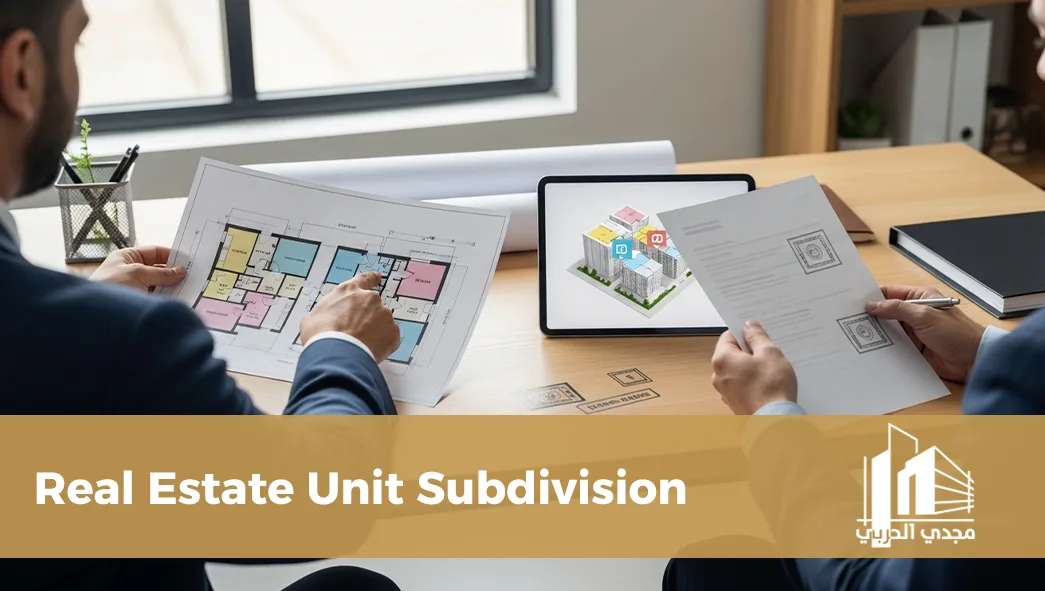
Real Estate Unit Sorting is a crucial step in organizing ownership within residential and commercial projects. Through this process, each owner’s unit is clearly defined and officially documented, facilitating sales or leasing transactions and reducing potential disputes over boundaries and areas.
In Saudi Arabia, compliance with the legal procedures for Real Estate Unit Sorting has become essential to protect owners’ rights and ensure that each unit obtains its independent title deed in accordance with the Saudi real estate regulations.
In this article, we will explore the steps of Real Estate Unit Sorting, its key benefits for property owners, and how real estate consultancy offices can assist in completing the process safely and efficiently.
What Is Real Estate Unit Sorting?
Real Estate Unit Sorting is an engineering and legal procedure through which a property (building or complex) is divided into separate units. The process defines each unit’s share of the total land area and common elements (such as entrances, elevators, and parking spaces).
This procedure transforms shared ownership into independent ownership, granting each owner full legal authority to dispose of their unit.
The Importance of Real Estate Unit Sorting in Organizing Ownership
Organizing Ownership Within Projects:
Real Estate Unit Sorting converts a single property into clearly defined units with specified boundaries and areas. This regulates relationships among owners and precisely defines their responsibilities.
Foundation for Development and Investment:
It is the essential step preceding the individual sale of units in new developments or the organization of ownership in existing buildings.
Supporting Urban Development Policies:
It aligns with urban planning strategies and facilitates the management of cities and related services such as electricity, water, and sewage.
Advantages of Real Estate Unit Sorting
Completing the Real Estate Unit Sorting process offers multiple benefits to property owners and the real estate market as a whole:
Protection of Owners’ Rights:
Each owner receives an independent title deed that legally confirms ownership of their unit and defines shared ownership rights (such as staircases, elevators, parking areas, and gardens), including ownership percentages.
Facilitating Sale, Mortgage, and Leasing:
Selling or mortgaging a unit becomes easier because it is recognized as an independent and clearly defined property. Leasing and property management are also simplified for individual owners.
Reducing Disputes and Legal Conflicts:
The process minimizes conflicts between current or future owners regarding ownership boundaries or shared usage. It also provides an official legal document that serves as a reference in case of disputes.
Organizing Financial Obligations:
It enables the separation of utility bills (electricity and water) per unit and regulates maintenance, insurance, and operational fees for shared facilities.
Requirements for Real Estate Unit Sorting in Saudi Arabia
To successfully complete Real Estate Unit Sorting in accordance with the Real Estate Unit Sorting Program under the Ministry of Municipal, Rural Affairs and Housing, the following requirements must be met:
- Valid Title Deed: An updated electronic deed for the land or property to be sorted.
- Building Permit: A valid construction permit consistent with the property’s current status.
- Completion Certificate: A certificate confirming that construction works have been completed in accordance with approved plans.
- Engineering Plans: Architectural drawings detailing unit layouts and areas.
Practical Steps for Completing Real Estate Unit Sorting in Saudi Arabia
The process follows structured procedures aligned with Saudi real estate regulations and directives issued by the Ministry of Justice and relevant authorities such as municipalities. The main steps include:
Preliminary Qualification:
Ensuring that the original property meets all required conditions, including a unified title deed, completed construction according to the permit, and settlement of all financial obligations.
Appointing an Approved Consultancy Office:
Engaging a licensed engineering or real estate consultancy office to conduct the technical study and prepare the required documentation.
Preparation of Technical Study and Sorting Plans:
The consultancy office prepares a detailed plan showing the boundaries, area, and location of each unit, along with precise identification of common areas.
Obtaining Municipal Approvals:
Submitting the sorting plans to the relevant municipality for technical and regulatory approval.
Submitting the Application to the Competent Authority:
Providing all required documents—including the original deed, municipal approvals, sorting plans, and owners’ declarations—to the real estate court or the competent office within the Ministry of Justice.
Legal Review and Verification:
Authorities review the documentation to ensure full compliance with regulatory requirements.
Issuance of Separate Title Deeds:
Upon approval, an independent title deed is issued for each real estate unit, registered under a unique number in the real estate registry.
Key Challenges in the Real Estate Unit Sorting Process
The Real Estate Unit Sorting process may encounter several obstacles, including:
- Inaccurate or unclear original property plans.
- Incomplete compliance with municipal regulations (building violations).
- Disputes over shared ownership percentages among owners.
- Administrative delays in some cases.
Tips to Overcome These Challenges
- Start Early: Avoid delaying Real Estate Unit Sorting, especially in new buildings intended for sale.
- Choose Reliable and Licensed Offices: Work with experienced consultancy firms specializing in Real Estate Unit Sorting.
- Ensure Municipal Compliance: Resolve any building violations before initiating the sorting process.
- Achieve Owner Agreement: When multiple owners are involved, obtain written approval and agreement on shared ownership percentages.
- Maintain Active Follow-Up: Assign a responsible party to coordinate with consultants and government authorities.
The Role of Real Estate Consultancy Offices in Real Estate Unit Sorting
Real estate consultancy offices play a fundamental role in every stage of Real Estate Unit Sorting, from technical studies to the issuance of title deeds, by providing:
Technical and Regulatory Expertise:
Comprehensive knowledge of municipal requirements, building codes, and Saudi real estate regulations.
Accurate Documentation and Planning:
Preparation of approved engineering drawings that form the backbone of the sorting application.
Government Liaison Services:
Facilitating communication with municipalities, the Ministry of Justice, and other authorities, while tracking procedures until completion.
Legal Advisory Services:
Advising clients on prerequisites and potential challenges, ensuring protection of all parties’ rights.
Saving Time and Effort:
Simplifying a complex process that requires detailed procedural expertise.
Real Estate Unit Sorting is more than a formal administrative step—it is an investment in the legal and financial stability of a property. It transforms ownership from an ambiguous status into a clear and secure one, granting owners full authority to manage and dispose of their assets with confidence.
Therefore, every property owner or investor in jointly owned property is strongly encouraged to complete the Real Estate Unit Sorting process and seek specialized expertise to ensure proper implementation. Doing so enhances property value and safeguards ownership rights in the long term.
Frequently Asked Questions (FAQ) About Real Estate Unit Sorting
What is the difference between Real Estate Unit Sorting and Land Subdivision?
Real Estate Unit Sorting: Applies to a single building, dividing it into independent residential or commercial units while maintaining shared ownership of common elements (such as foundations and entrances).
Land Subdivision: Applies to vacant land, dividing it into completely independent land plots.
Who can request Real Estate Unit Sorting?
The original property owner—whether an individual or a development company—may request the sorting. If multiple owners exist, approval from all owners or their legal representatives is required.
How long does Real Estate Unit Sorting typically take?
The duration varies depending on property complexity and administrative workload but may range from several months to a year or more in certain cases.
Can units in an old building or one with building violations undergo Real Estate Unit Sorting?
Municipal violations must first be resolved and a Completion Certificate (or equivalent) obtained before initiating official sorting procedures. Older buildings require approved plans reflecting their current condition.
What is the cost of Real Estate Unit Sorting?
Costs include consultancy fees, municipal fees, and real estate registration fees with the Ministry of Justice. The total varies depending on the project size, number of units, and overall complexity.